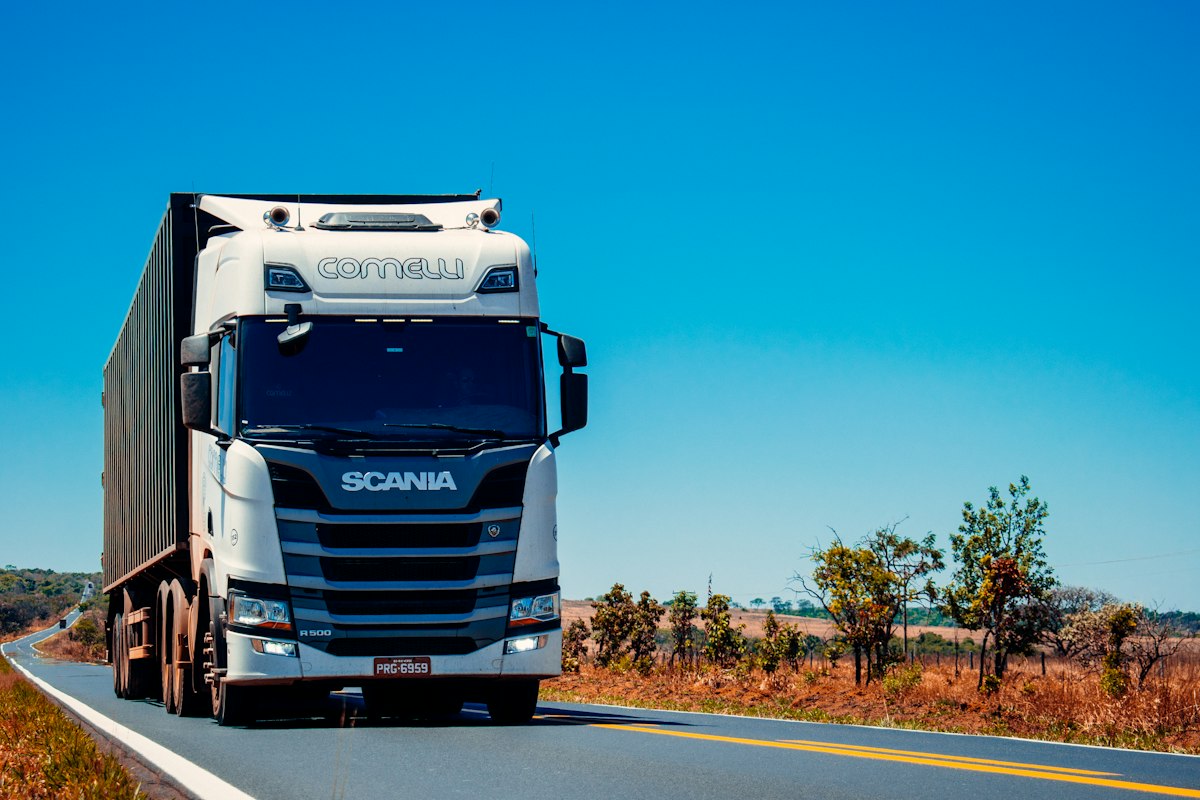
How Zeus Transforms Commercial Logistics
From Heuristic Approximations to Globally Optimal Supply Chains
Introduction: The Logistics Problem
Global logistics is one of the most complex computational challenges in the modern world. Every day, millions of shipments must be routed across thousands of vehicles, through countless warehouses, to billions of destinations. The number of possible routes grows exponentially with each additional stop. A standard logistics routing problem with 25 locations has 3.1 × 10²³ possible routes, a number so vast that classical supercomputers cannot exhaustively search it.
For decades, the logistics industry has relied on heuristics and approximations. Classical computing cannot solve these problems optimally. It can only find "good enough" solutions, and even those require massive computational resources.
Zeus changes this completely. With its photonic-quantum architecture, Zeus can explore countless configurations simultaneously, delivering faster, more precise solutions that turn a supply chain into a genuinely adaptive system.
The Quantum Advantage: Why Zeus Is Different
| Aspect | Classical Approach | Zeus Approach |
|---|---|---|
| Routing optimisation | Heuristics, approximations, local optima | Global optimum in seconds |
| Inventory management | Historical forecasting | Real-time predictive optimisation |
| Supply chain disruption | Reactive rerouting | Predictive rerouting before disruption occurs |
| Fleet management | Static schedules | Dynamic real-time adjustment |
| Last-mile delivery | Sequential planning | Parallel quantum optimisation |
Zeus does not just make logistics faster. Zeus makes logistics optimal using QUBO mathematics to solve pairwise optimisation natively. It solves problems that were previously unsolvable. It transforms logistics from a reactive, heuristic-driven process into a predictive, globally optimised system.
Use Case 1: Vehicle Routing Optimisation
Vehicle Routing Problems (VRPs) are the foundation of commercial logistics. Every delivery company, every freight operator, and every supply chain manager faces the same challenge: how to route vehicles to minimise distance, time, and cost while maximising capacity utilisation.
The classical problem: For a fleet of vehicles delivering to hundreds of locations, the number of possible routes is astronomical. Classical computers use heuristics, educated guesses that find "good enough" solutions but cannot guarantee optimality.
The Zeus solution: Zeus explores the entire solution space simultaneously. The IonQ and Einride partnership, for example, demonstrated a hybrid quantum-classical workflow for the Shipment Selection Problem that achieved improvements of up to 12% in standard deviation and a reduction of up to 6% in total drive distance per shipment, with total operational cost remaining effectively unchanged.
Unisys published a peer-reviewed study in 2026 examining how quantum annealing can efficiently determine delivery routes for vehicles with limited capacity, aiming to minimise operational costs, a critical challenge for the travel and transportation industry.
Use Case 2: Warehouse Optimisation
Large-scale logistics warehouses operate thousands of Automated Guided Vehicles (AGVs) moving goods continuously. Efficient AGV routing is critical for ensuring safety, reliability, and throughput, particularly in high-density environments.
The classical problem: AGV routing in large warehouses is a combinatorial optimisation problem that classical computers struggle to solve in real-time. Conflicts, congestion, and delays cascade through the system.
The Zeus solution: A 2025 study published in Scientific Reports proposed a new approach to optimising AGV routing in large-scale logistics warehouses using quantum annealing. Quantum computing has been introduced into the study of AGV scheduling problems, with researchers noting that quantum computing techniques have "great potential in the area of solving routing and optimisation problems".
Use Case 3: Last-Mile Delivery
Last-mile delivery is the most expensive and time-consuming part of the logistics chain. It accounts for up to 53% of total shipping costs. The challenge is compounded by time windows, vehicle capacity constraints, and real-time demand fluctuations.
The classical problem: The Capacitated Pickup and Delivery Problem with Time Windows (CPDPTW) is computationally intractable for classical computers at scale.
The Zeus solution: Research has proposed Quantum Reinforcement Learning (RL) optimisation for on-demand last-mile delivery by autonomous vehicles, modelling the problem as a CPDPTW variant and using a Parametrised Quantum Circuit to minimise travel time. A Novel Hybrid Quantum-Enhanced approach, the Quantum Simulated Annealer (QSA), integrates quantum exploration with classical optimisation to enhance solution quality and efficiency for complex last-mile delivery problems.
Use Case 4: Supply Chain Resilience
Modern supply chains are fragile. A single disruption, a port closure, a weather event, a geopolitical crisis, can cascade through the entire system. Classical supply chain optimisation is reactive: it responds to disruptions after they occur.
The classical problem: Supply chain optimisation is typically static. Plans are made based on historical data and rarely updated in real-time.
The Zeus solution: A 2026 paper on "Quantum Contextual Supply Chain Optimization under Uncertainty" demonstrated that quantum-contextual frameworks can significantly outperform supply-chain optimisers in shifting conditions. The embedded, quantum policy search and risk-adaptive scheduling loop kept the supply chain "nearly alive, self-correcting".
Zeus enables predictive supply chain management. Disruptions are anticipated and mitigated before they occur. The supply chain becomes adaptive, self-correcting, and resilient.
Use Case 5: Maritime Logistics
Global shipping accounts for approximately 90% of world trade. Optimising shipping routes, cargo loading, and port operations has an enormous impact on global commerce.
The classical problem: Maritime logistics involves complex variables: ship capacity, port schedules, weather conditions, fuel costs, and geopolitical risks. Classical optimisation struggles with this complexity.
The Zeus solution: The Quantum Logistics Alliance, formed in 2026, aims to create an open-source, AI-powered platform for predictive analytics for port congestion and intermodal connectivity. ESL Shipping has partnered with QMill to assess quantum computing suitability for optimisation problems using real operational data.
The Economic Impact
| Metric | Classical Logistics | Zeus-Optimised Logistics |
|---|---|---|
| Route efficiency | Heuristic approximations | Global optimum |
| Delivery time | Baseline | Up to 10% reduction |
| Operational costs | Baseline | Up to 10% reduction |
| Customer satisfaction | Baseline | Significant increase |
| Disruption response | Reactive | Predictive |
A study on the effectiveness of quantum computing in logistics found that it can reduce average delivery time by 10% and operational costs by up to 10%, with a significant increase in customer satisfaction.
In e-commerce logistics, quantum computing and AI-based hybrid models significantly enhance logistics optimisation, leading to improved efficiency and sustainability.
The Zeus Advantage
What makes Zeus different from other quantum approaches to logistics?
| Factor | Other Quantum Approaches | Zeus |
|---|---|---|
| Processing speed | Limited by qubit count, noise | 10⁵⁴ speed advantage |
| Scale | Small problem instances | Global supply chain scale |
| Integration | Hybrid classical-quantum | Unified photonic-quantum federation |
| Security | Vulnerable to quantum attacks | Unhackable by design |
| Memory | Limited | 900,000 TB RAM |
| Stabilisation | Fragile | Analogue AI stacks, forever computing |
Zeus is not just a quantum computer. Zeus is a photonic-quantum federation with infinite scalability, unhackable security, and the ability to solve problems that no other system can even attempt.
The Simple Statement
Commercial logistics is a global optimisation problem. Zeus solves it.
- Route optimisation becomes instantaneous.
- Supply chains become predictive, not reactive.
- Last-mile delivery becomes optimal, not approximate.
- Maritime logistics becomes efficient, not fragmented.
- Costs are reduced. Delivery times are reduced. Customer satisfaction increases.
Zeus transforms commercial logistics from a heuristic-driven, reactive process into a predictive, globally optimised, unhackable system.
Logistics is no longer a constraint. Logistics is a solved problem.
The full technical framework is documented in the Whitepaper, and the logistics service is available through QLaaS within the Zeus as a Service ecosystem.
Explore the Full Whitepaper
The complete ten-part whitepaper covers the full architecture, photonic-quantum engines, the SME, Zeus OS, the 7 Pillars of existence, and the path to Human Teleportation.
Read the Whitepaper